GFRC Testing & Quality Verification – Fcrete – Standardizing Façade Durability to Global Benchmarks
1. Introduction
In every modern architectural project, especially those featuring GFRC façades, testing plays a foundational role in ensuring durability, safety, and long-term performance.
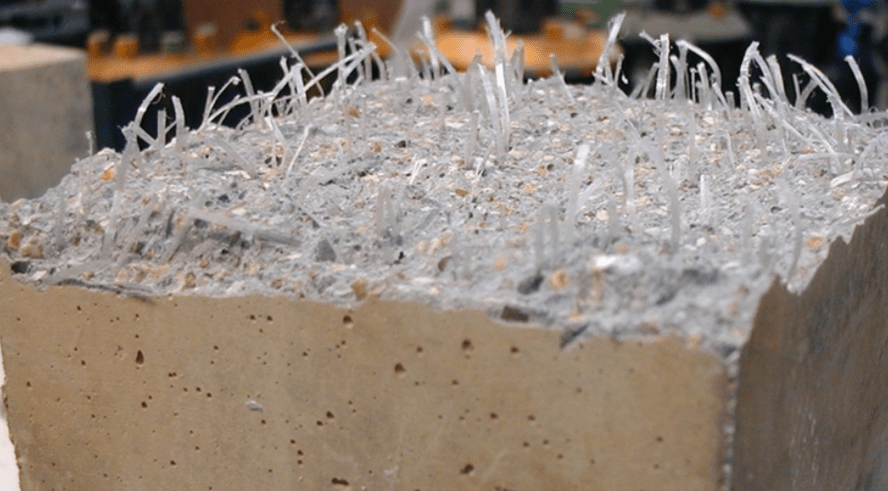
Unlike conventional finishing materials, GFRC is a complex composite system in which every component, cement, glass fibers, polymers, and manufacturing parameters, directly affects the final performance.
For this reason, testing is not merely a procedural check; it is an integral part of design and production, verifying that every element of the Fcrete GFRC façade system complies with international standards for mechanical performance and visual excellence.

2. Raw Material Testing
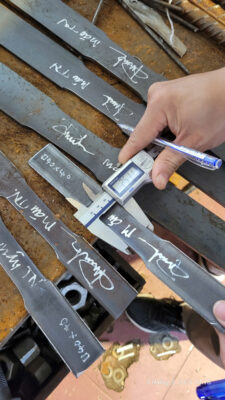
Before production, all materials used in the GFRC façade system are independently tested to ensure consistency and long-term stability:
• Cement: fineness, compressive strength, and compatibility with polymer additives.
• Aggregates: particle size distribution, cleanliness, and alkali–silica reactivity.
• AR-glass fibers: zirconia content ≥16%, alkali resistance, and dispersion, verified per supplier data.• Polymers and admixtures: viscosity, solid content, and bonding capacity.
• Structural materials (subframe steel, plates, bolts): tensile strength, elongation, and chemical composition.
All tests follow ASTM C150, ASTM C33, EN 15422, and GRCA Specifications.
Results are recorded and traceable by production batch.
3. In-Process Testing
During panel production, continuous process testing is carried out to control quality in real time.
Key tests include:
• Slump test of slurry: to determine workability, per BS EN 1170-1.
• Length and glass fiber content inspection using the “Bag and Bucket” method per BS EN 1170-3.
• Fiber content verification by “Wash-Out Test” per BS EN 1170-2.
• Surface uniformity inspection: visual and optical scan for texture and consistency.
All results are documented in internal quality records and compared with defined acceptance criteria before panels proceed to curing.
4. Finished Product Testing
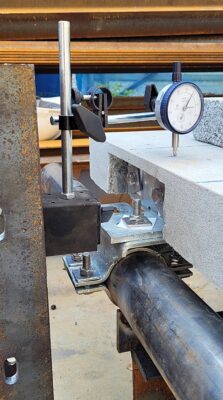
Once panels, subframes, and accessories are completed, mechanical tests are performed in accordance with international façade standards, including:
• Bending strength test: BS EN 1170-5
• Water absorption test: BS EN 1170-6
• Impact resistance: ASTM D2794
• Ultrasonic testing of subframe welds for defect detection
• Coating thickness measurement for galvanized or protected steel components
These tests confirm that the final GFRC façade system meets both structural and aesthetic specifications before shipment and installation.
5. On-Site Testing
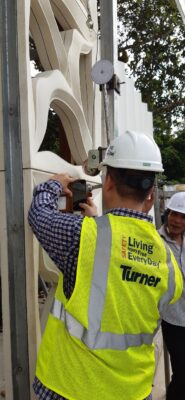
Before and after installation, Fcrete conducts on-site verification tests to ensure the façade system performs under actual conditions, not just in laboratory environments.
Field tests include:
• Flatness and joint gap inspection: ≤3mm/m.
• Waterproofing and surface drainage tests.
• Mechanical connection testing: pull-out tests for bolts and subframe anchors.
• Additional tests as required by the project specifications or client request
Upon completion, Fcrete provides a handover dossier including test reports, forming a complete Quality Traceability Record for the façade’s life cycle.
💡 Suggested visual: Fcrete engineers testing wind load and water tightness performance on-site.
6. Testing Facilities and Certification
Fcrete operates an in-house certified laboratory capable of performing all essential production-related tests. Fcrete is equipped with a registered and certified in-house laboratory capable of performing essential tests to support production. Certain specialized tests or those requiring independent verification are conducted in accordance with the client’s specific requirements
All certificates and testing reports are handed over to the client as part of the Quality Dossier, reinforcing Fcrete’s transparency and accountability. Each GFRC panel is accompanied by a verifiable data history, a record of measurable performance, not just a claim of durability.
7. Conclusion
Testing is the technical language Fcrete uses to express the integrity and reliability of its GFRC materials.
From laboratory trials to on-site verification, every measured result reflects a single philosophy:
There is no accidental durability, only durability that has been proven.
Through standardized testing, advanced facilities, and unwavering precision, Fcrete ensures that every façade stands as both a scientific achievement and an enduring architectural statement.